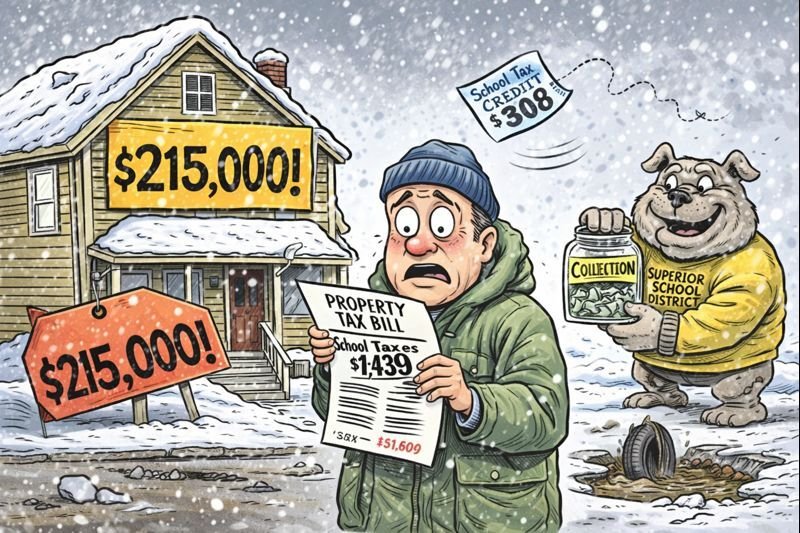
The New Game in Town: “Your House Went Up, So Pay Up”
If you own a home in Superior, Wisconsin, congratulations: your property’s “value” jumped and now your tax bill is doing CrossFit.
We’re using an “average” home valued at $165,000 through 2024, then the classic Superior plot twist:
2025: BOOM → $215,000
2026: still $215,000
And now the Superior School District is back in the mix with 2025 mill rates that don’t just “impact” you—they move in and start eating your groceries.
📌 2026 School District Mill Rate (City of Superior) — The Real Numbers
From the 2025 Net Mill Rate Report for City of Superior (Code 281):
Superior School District tax rate: 0.008135566
School credit rate: 0.001432509
Net after school credit: 0.006703057 (that’s the district rate minus the credit rate)
Equalized Value School Tax Credit value shown: 0.007648040 (this is the school credit factor noted on the report)
This is the part where officials say, “See? Credits!” and expect you to applaud like it’s a 1990s infomercial.
What That Means for a $215,000 Home in 2025
Let’s do the wallet surgery:
✅ Gross school tax (before credit)
$215,000 × 0.008135566 = $1,748.15
✅ School credit
$215,000 × 0.001432509 = $308.99
✅ Net school tax (after credit)
$1,748.15 − $308.99 = $1,439.16
So for 2026, the school district’s bite out of a $215K home is roughly:
💸 $1,439/year — and no, that does not include city, county, tech college, or the “we swear this will help” add-ons.

Now Let’s Compare It to When Your Home Was $165K (2019–2023)
When your home value stayed at $165,000, school taxes were basically “steady” — the way a dripping faucet is “steady.”
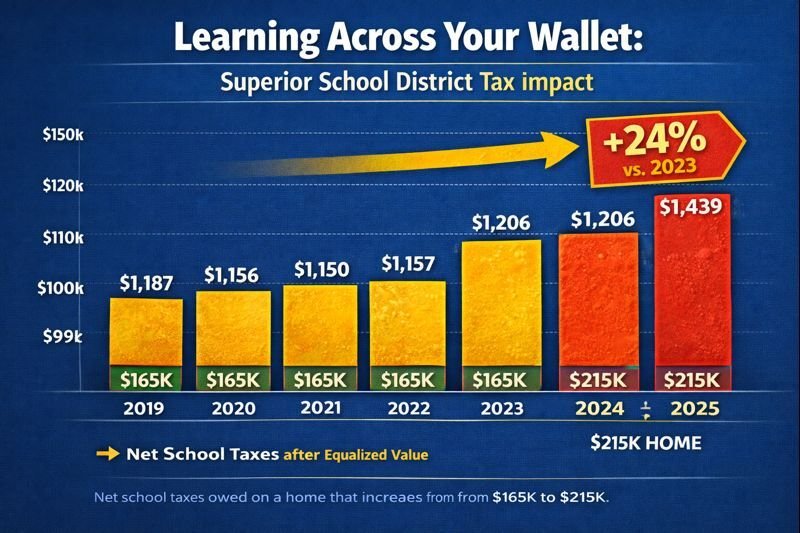
Here are net school taxes from earlier years we discussed (credit included):
2019: ~$1,187
2020: ~$1,156
2021: ~$1,150
2022: ~$1,157
2023: ~$1,159
Then the value jumps and you’re suddenly in a new tax bracket like you got drafted into the NBA.
💥 The 2024 → 2025 Shift: The Sneaky Part
Here’s where it gets extra spicy.
In 2025, we had a lower school mill rate, and your school credit seemed to cushion the blow.
But in 2026:
School district mill rate goes UP
School credit rate doesn’t rise enough to cover it
And since your home value is already inflated, your bill gets punched in the face with better math
Net school tax goes to ~$1,439, which is:
About $280 more than 2025
About a 24% jump in the school portion alone, compared to your $165K-era baseline
And yes, they’ll still say “rates aren’t that bad.”
Buddy, my cholesterol isn’t that bad either—until you look at the numbers.

So What the Hell Is the School Tax Credit?
Think of the School Tax Credit like Wisconsin handing you a coupon after the checkout clerk already scanned your full cart.
✅ What it does:
It reduces your school taxes on your property tax bill.
It’s based on equalized value, not assessed value.
It’s shown in the mill rate report as a credit rate and applied locally.
❌ What it doesn’t do:
It does NOT stop your taxes from rising when your home value jumps.
It does NOT guarantee your bill goes down even if the school mill rate drops.
It does NOT protect you from “we need more funding” vibes.
So yes—credits exist.
But when values leap like yours did, the credit becomes a band-aid on a broken leg.
🎤 Mic Drop: The “Lower Rate” Trick Still Costs You More
Here’s the whole scam in one sentence:
They can talk about “rates” all day, but your taxes follow value— and your value just got launched into orbit.
So in 2026, the Superior School District doesn’t just “impact” your taxes—
it now owns a penthouse in your escrow account.
#PayUpSuperior
#SadderYou

Superior Spent $50,000 So Mayor Jim Paine Could Nap in Peace
Mayor Jim Paine claims transparency over a known conflict in promotions, but this scandal reveals a troubling lack of accountability in City Hall.

Wisconsin News You Should Know: Milwaukee Cop Allegedly Used Flock Like a Creepy Ex With a Badge
Milwaukee officer charged for misusing surveillance tech highlights growing concerns over mass surveillance and public trust issues in Wisconsin.

BUDGETS? WHAT BUDGETS?! City Hall Blows $1.3 MILLION Past Budget Limits Like Taxpayer Money Grows on Lake Superior Ice
City departments exceeded budgets significantly, raising questions about fiscal oversight. Discover which departments are over budget and by how much.

Court Docs – Civil Rights and FLSA Complaint – LeRette v. City of Superior & Champaigne (March 7, 2025)
Mikayla LeRette sues the City of Superior for warrantless GPS tracking and inadequate lactation space, alleging civil rights violations.

Election 2026: Voters vs. the Budget That Ate Superior
Superior’s budget grew nearly 50% in six years, even as the city’s population shrank. Per-resident government spending jumped from $1,947 in 2018 to $2,908 in 2024, leaving taxpayers carrying about $1,000 more government per year than they did just a few years ago. Property tax revenue barely moved during the same period, meaning much of the spending surge has been fueled by outside funding, borrowing, and one-time aid. When spending rises while the population falls, the math gets uncomfortable fast — and eventually the bill comes due.